



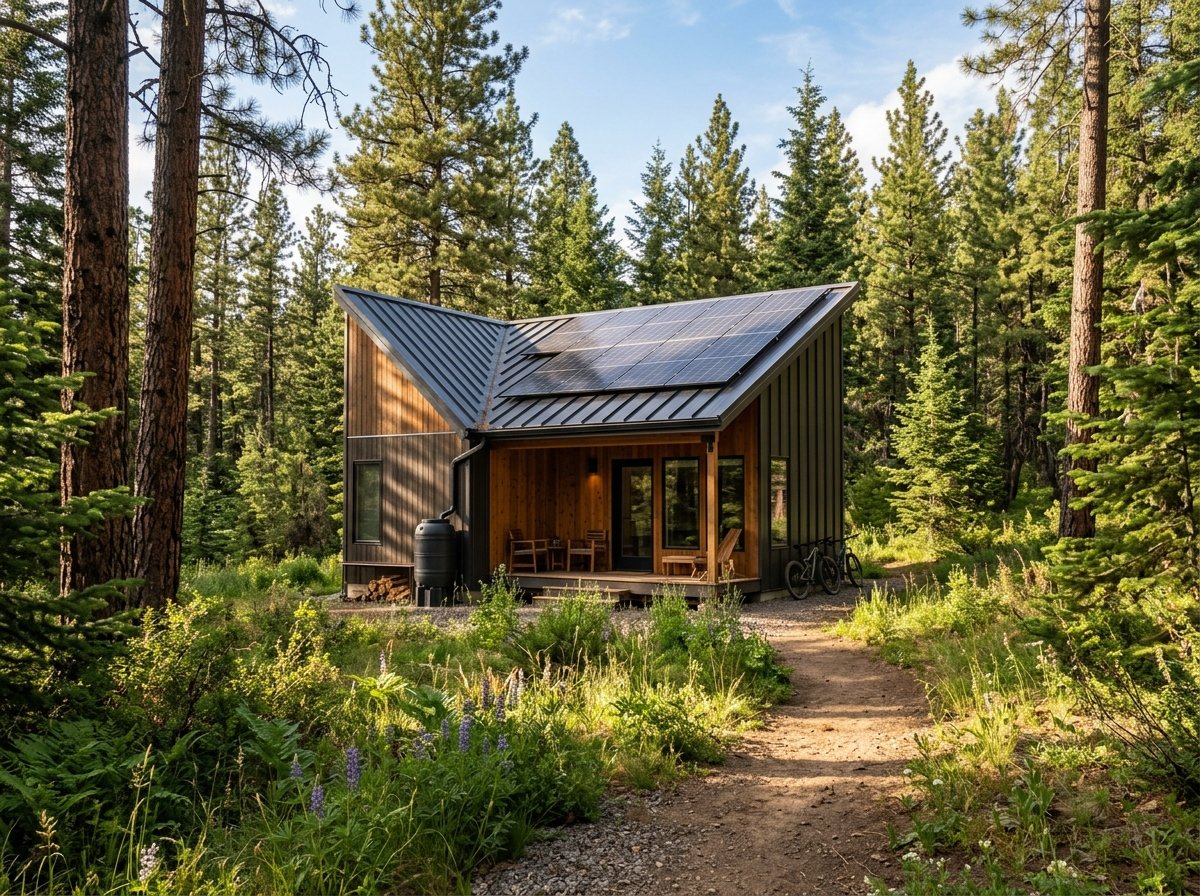
Picture a weekday morning: birds, no neighbors, no utility bill. The cabin arrived on a flatbed. You were sleeping in it within weeks. That used to sound like a fantasy. It isn’t anymore. A new generation of prefab cabins pairs factory precision with solar arrays, battery banks, rainwater harvesting, and composting waste systems to create dwellings that run entirely without municipal connections. The question isn’t whether off-grid prefab works. The question is how to put the pieces together so your cabin keeps the lights on in January and the water flowing in August.
Why prefabrication and off-grid living are a natural fit
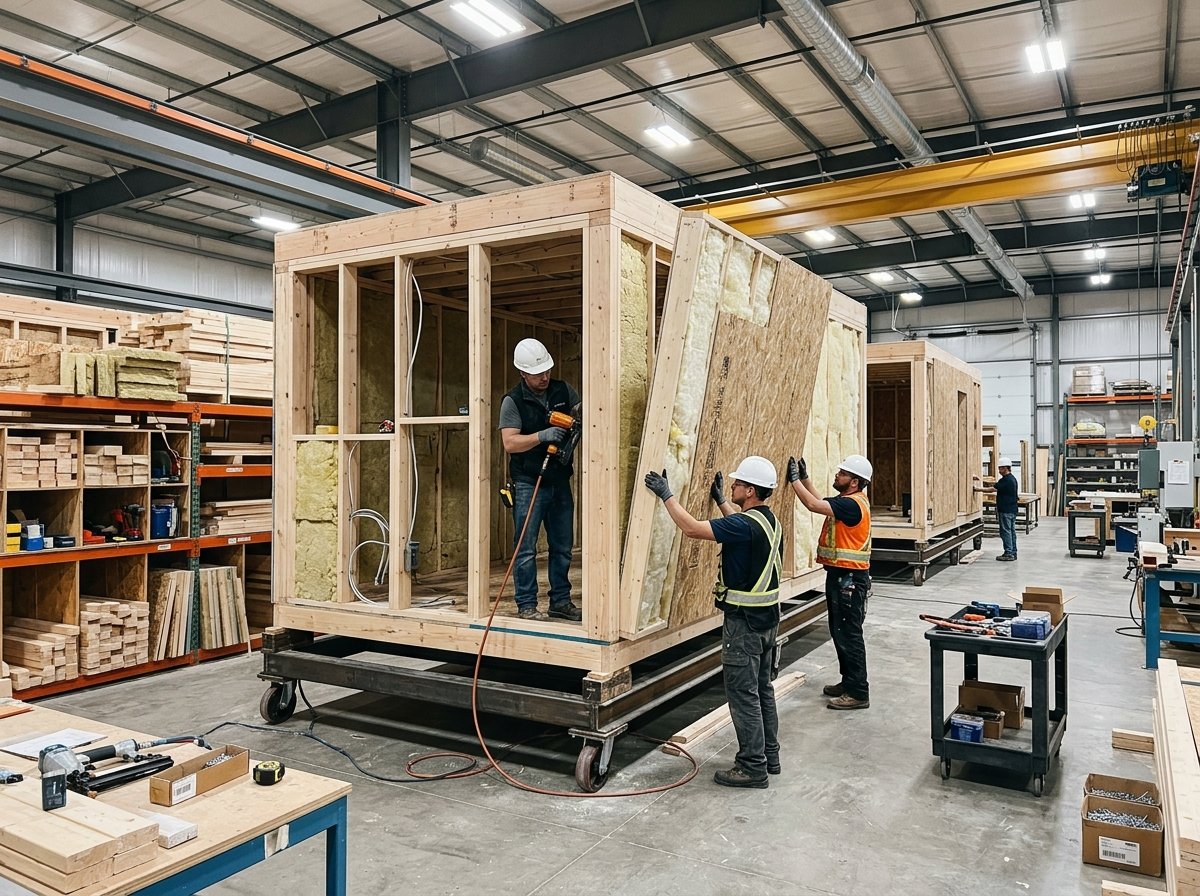
Off-grid living demands tight systems thinking. Every watt of electricity, every gallon of water, every BTU of heat has to be generated, stored, or treated on site. That kind of closed-loop engineering happens most reliably in a controlled factory environment, not on a muddy rural lot with a rotating crew of subcontractors.
Factories run on consistency. Walls get sealed the same way every time, insulation doesn’t get left out in the rain, and quality checks happen before the truck leaves. That discipline matters enormously for an off-grid cabin, where a leaky envelope bleeds the energy your solar array worked hard to collect. The U.S. Department of Energy is direct on this point: building envelope quality, particularly insulation continuity and reduced air infiltration, ranks among the most cost-effective ways to cut a home’s total energy load. Tighten the shell and you shrink the solar array you need to buy.
Modern prefab cabins, whether compact backyard-sized units or larger seasonal retreats, tend toward mechanical simplicity: open floor plans, fewer partition walls, windows placed for passive solar gain. Those choices are easier to execute in a factory than on a job site. They also make it straightforward to route conduit for solar wiring, rough-in a composting toilet, or tuck in a battery inverter without rebuilding the interior afterward.
Solar power: sizing the system for a remote cabin
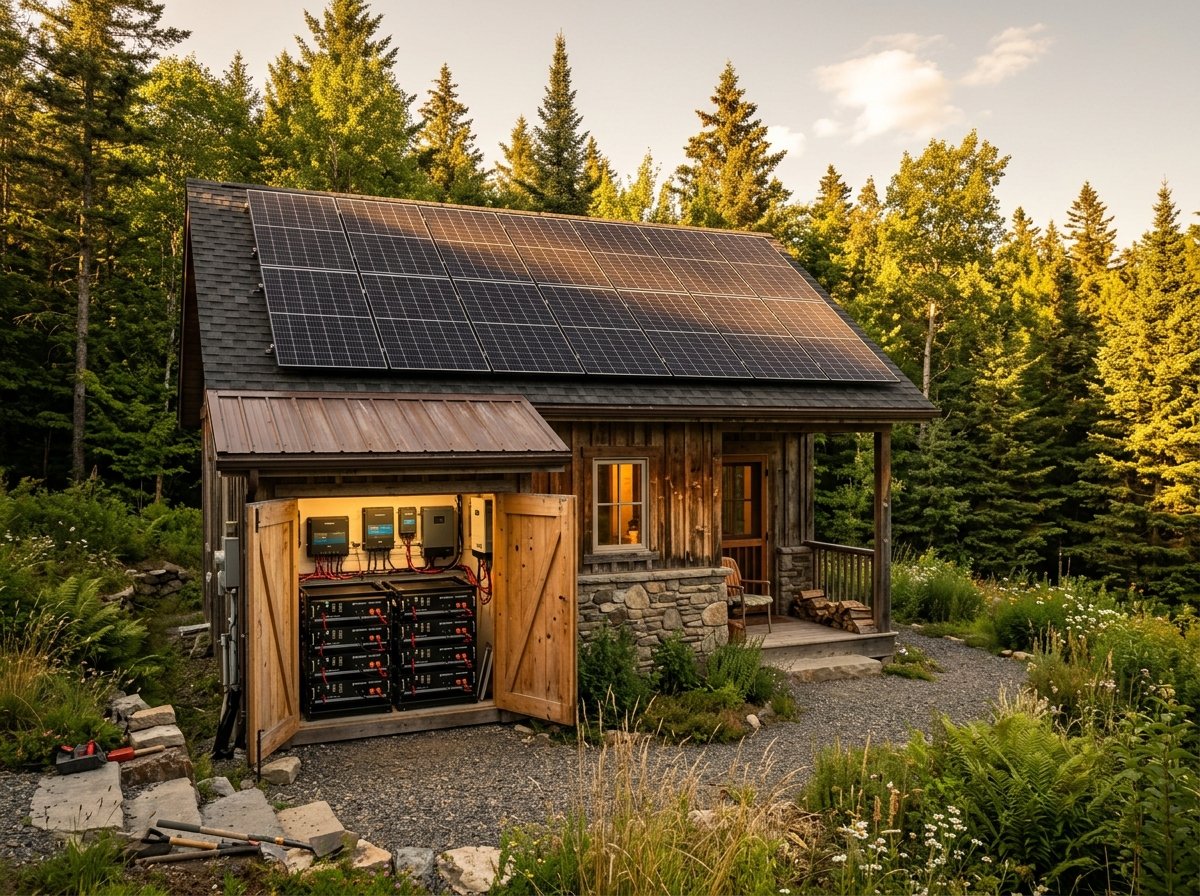
Three variables drive any off-grid photovoltaic setup: panels that generate electricity, batteries that store it, and an inverter or charge controller that manages flow between them. Get the balance wrong and you’re rationing power or throwing money at oversized equipment.
Start with your load. The U.S. Energy Information Administration puts average American household consumption at roughly 10,500 kilowatt-hours per year. For a cabin, that number is largely irrelevant. A part-time retreat or hunting base, run by occupants who pay attention to appliance loads, can come in under 3,000 kWh annually. That gap drives every purchasing decision downstream.
The National Renewable Energy Laboratory publishes PVWatts, a free calculator that estimates solar output for any U.S. location using historical irradiance data. Running your cabin’s estimated daily load through PVWatts before you finalize a purchase is one of the most grounded steps you can take. Sunnier states like Texas and Tennessee generally allow smaller arrays for the same load than cloudy northern climates, which is one practical reason prefab cabins in Texas and across the Southeast attract strong off-grid interest.
Battery chemistry matters too. Lithium iron phosphate (LFP) batteries have pushed lead-acid aside for most off-grid applications. The DOE’s Office of Energy Efficiency and Renewable Energy documents LFP at roughly 2,000 to 5,000 charge cycles at 80 percent depth of discharge, versus 500 to 800 cycles for flooded lead-acid at 50 percent depth of discharge. That difference translates directly into long-term cost per kilowatt-hour delivered.
Water systems: collection, filtration, and storage
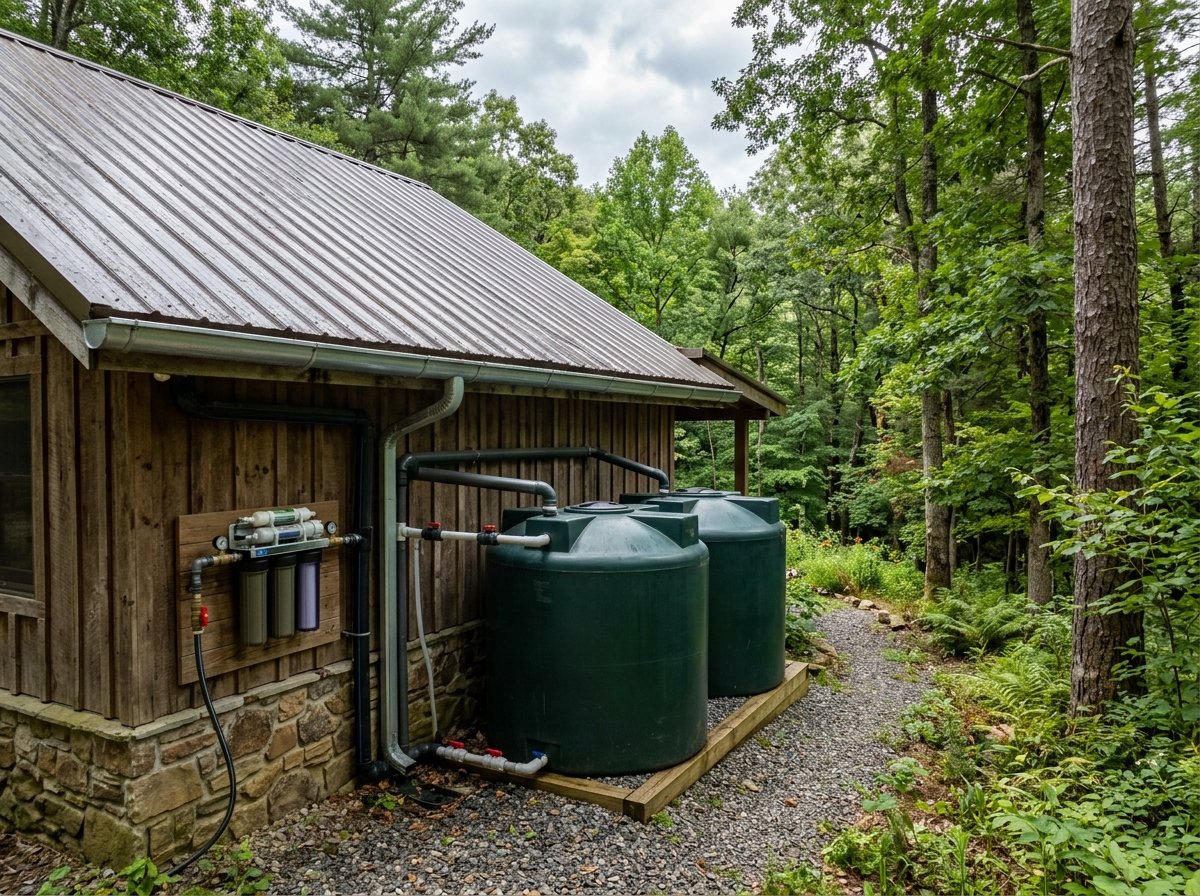
Cut the utility connection and you cut the water line too. Off-grid cabins have to source every gallon on site, which means choosing among several imperfect options and engineering around each one’s constraints.
Off-grid cabins typically rely on one or more of these sources:
- Rainwater harvesting: Roof area and local average rainfall determine catchment potential. The American Rainwater Catchment Systems Association calls for first-flush diverters, closed storage tanks, and multi-stage filtration (sediment, carbon, and UV) before the water reaches a drinking glass or a pot.
- Private wells: Drilling depth, pump power requirements, and water quality vary sharply by location. The EPA recommends testing annually for coliform bacteria, nitrates, and pH.
- Hauled water with a cistern: Works for seasonal prefab hunting cabins or weekend retreats where occupancy is low and daily demand stays manageable.
- Surface water with filtration: Permitted in some rural jurisdictions, but multi-stage treatment is required to meet EPA safe drinking water standards.
Insulating water lines and storage tanks against freeze risk is non-negotiable in most of the country. Prefab log cabins with thick wall assemblies have a thermal advantage here, since the cabin’s interior stays warmer with less heating energy, which reduces the risk of frozen pipes during cold snaps.
Waste systems: going beyond the flush
Connecting to a municipal sewer isn’t an option off the grid. The two most common alternatives are a conventional septic system and a composting toilet paired with a greywater system.
A conventional septic system requires a percolation test, a county permit, and enough land area for a drain field. The EPA’s SepticSmart program notes that a properly designed and maintained system can last 25 to 30 years, though it does require periodic pumping, usually every three to five years depending on household size and use patterns.
Composting toilets eliminate the need for a septic tank entirely for blackwater, though most jurisdictions still require an approved system for greywater (sinks, showers, laundry). Greywater can often be discharged through a simple mulch basin or subsurface drip field, subject to local health department approval. For truly remote prefab tiny cabins or seasonal structures, composting toilets combined with greywater irrigation represent the lowest-infrastructure waste solution available.
Comparing the main off-grid systems at a glance
| System | Primary Function | Key Sizing Variable | Maintenance Interval |
|---|---|---|---|
| Solar PV + Battery | Electricity generation and storage | Daily kWh load and local solar irradiance (NREL PVWatts) | Battery state-of-health check annually; panel cleaning as needed |
| Rainwater Harvesting | Potable and non-potable water supply | Roof catchment area and average monthly rainfall (NOAA data) | Filter cartridge replacement per manufacturer schedule; tank cleaning annually |
| Septic System | Blackwater and greywater treatment | Daily wastewater volume and soil percolation rate (EPA SepticSmart) | Pump every 3 to 5 years (EPA SepticSmart) |
| Composting Toilet + Greywater | Waterless waste processing | Occupancy frequency and local health department approval | Empty compost chamber per manufacturer schedule; greywater field inspection annually |
Choosing a builder: what to look for in off-grid prefab
Not every prefab manufacturer has experience integrating off-grid systems. Whether you’re drawn to modern prefab cabins with clean lines and metal roofing or rustic prefab Amish cabins crafted from timber, the questions that matter most are practical ones. Reviewing resources like side-by-side builder comparisons can save significant research time.
- Does the manufacturer pre-wire and pre-plumb the structure for off-grid systems before delivery?
- Is the wall and roof assembly sufficient to meet your climate zone’s insulation requirements under the DOE’s residential building energy codes?
- Does the builder have established relationships with off-grid system integrators, or will you need to source those contractors independently?
- What certifications does the structure carry? HUD-code manufactured homes, modular units built to state residential codes, and panelized systems each carry different regulatory implications for financing and permitting.
Understanding prefab cabins prices in the off-grid context also means accounting for system costs beyond the structure itself. The cabin shell is one line item. The solar array, battery bank, water filtration, and waste system are additional line items that can collectively equal or exceed the cost of the cabin in some remote locations. You can also explore how prefab compares to traditional construction costs to frame those numbers in context.
Permits and land: the variables that surprise buyers most
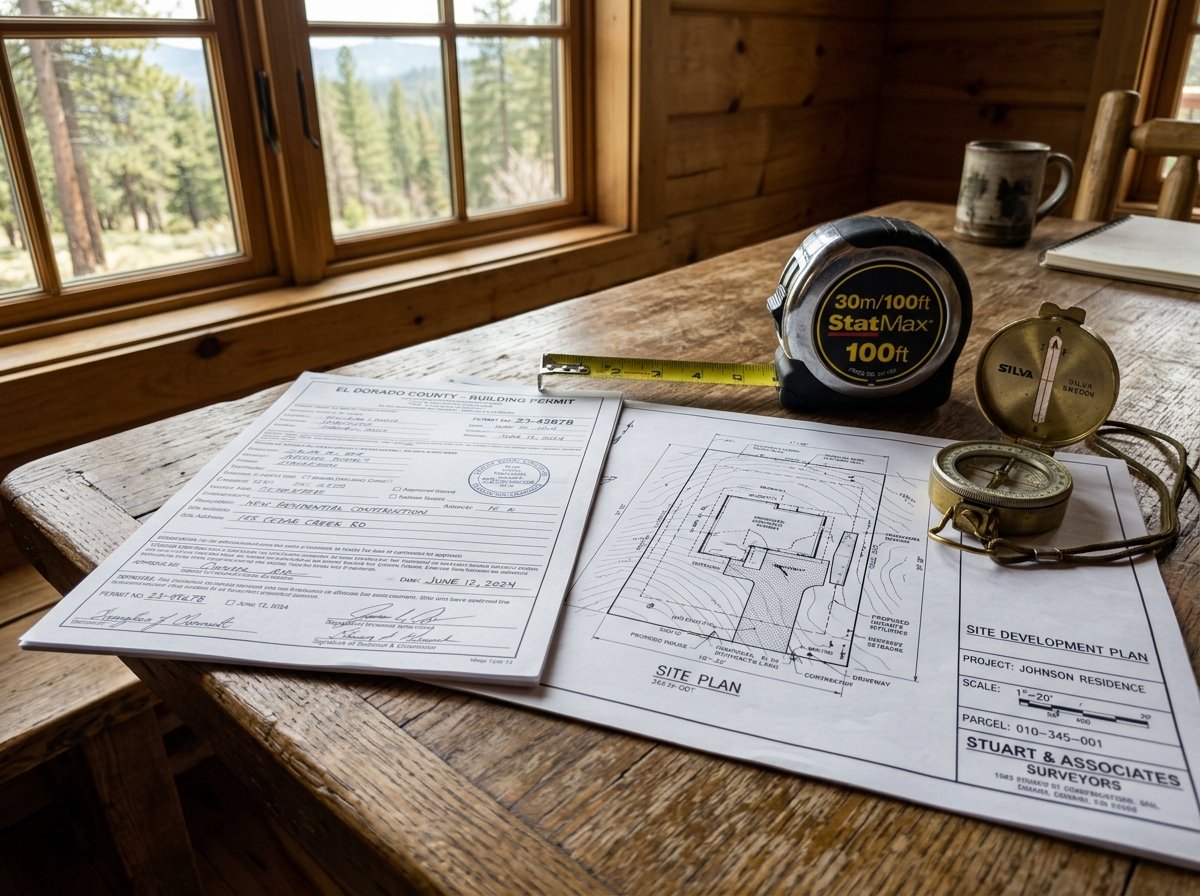
Even in rural counties with minimal zoning restrictions, some form of permitting is almost always required for a permanent or semi-permanent structure with a septic system or well. Common hurdles include minimum lot size thresholds, setback requirements, and health department approval for water and waste systems. All of these differ county by county and state by state.
Working with a builder experienced in your target region is often the single most effective way to navigate this process. Builders with a track record in prefab cabins in Tennessee or rural Texas will know which counties require a licensed engineer’s stamp on the foundation plan and which accept manufacturer drawings directly.
Frequently asked questions about off-grid prefab cabins
How much solar power does an off-grid cabin typically need?
Occupancy pattern, appliance loads, and local solar irradiance all pull the number in different directions. The U.S. EIA puts average household consumption at roughly 10,500 kWh per year; a part-time cabin can land well below 3,000 kWh. Run your estimated daily load through the NREL PVWatts calculator for your specific location before calling a single solar installer.
Can a prefab cabin legally use a composting toilet?
In many jurisdictions, yes, but approval isn’t automatic. Local health departments typically require a permitted composting toilet unit (NSF/ANSI Standard 41 listed units are widely accepted), a separate approved greywater disposal method, and proof that the system meets state plumbing and sanitation codes. Check with your county health department before purchasing a unit or finalizing a floor plan.
Do off-grid cabins require building permits even in rural areas?
Yes, with rare exceptions. A septic system or well almost always needs a county health department permit. A permanent structure needs a building permit. Call the county planning and building department for the specific parcel before you buy land or order a cabin.
Are prefab log cabins a good option for off-grid use?
They can be well-suited to off-grid use because their thick wall assemblies provide thermal mass that moderates interior temperature swings. The trade-off is that log walls may not meet modern code-minimum insulation R-values in colder climates without supplemental insulation layers. Confirm that the wall assembly meets your climate zone’s requirements before committing to a specific manufacturer.
What should I look for in small prefab cabins designed for off-grid use?
- Pre-wired conduit runs sized for solar system integration
- Pre-plumbed connections compatible with tankless or on-demand water heaters
- Roof pitch and orientation suitable for panel mounting with adequate solar exposure
- Insulation values that meet or exceed your climate zone’s DOE code minimums
- Structural documents accepted by your target county’s building department
Reviewing curated lists like top compact prefab homes for small-footprint living can help you identify which manufacturers publish those specifications clearly.
Sources
- U.S. Energy Information Administration. (2023). “How much electricity does an American home use?” https://www.eia.gov/tools/faqs/faq.php?id=97&t=3
- U.S. Department of Energy, Office of Energy Efficiency and Renewable Energy. (2023). “Lithium-Ion Battery Basics.” https://www.energy.gov/eere/articles/how-does-lithium-ion-battery-work
- National Renewable Energy Laboratory. “PVWatts Calculator.” https://pvwatts.nrel.gov/
- U.S. Environmental Protection Agency. “SepticSmart: Homeowner Information.” https://www.epa.gov/septic/septicsmart-homeowner-information
- U.S. Environmental Protection Agency. “Private Drinking Water Wells.” https://www.epa.gov/privatewells
- U.S. Environmental Protection Agency, WaterSense. “Statistics and Facts.” https://www.epa.gov/watersense/statistics-and-facts
- U.S. Department of Energy. “Residential Building Energy Codes.” https://www.energycodes.gov/residential
- American Rainwater Catchment Systems Association. “ARCSA Standards and Guidelines.” https://arcsa.org/page/Standards
