



Foundation Terminology
Let’s dig into the ground, literally. The term “foundation” in prefab and ADU construction refers to the load-bearing structure beneath the house. It’s what keeps the home steady and stable. You might often hear the terms “permanent” and “temporary” foundations. A permanent foundation, like a slab, is typically poured concrete and provides lasting support, akin to the strong spine of a building. On the other hand, temporary foundations, including pier and raised foundations, offer flexibility and are ideal for areas requiring relocation or minimal site disruption.
Proper site preparation is key to ensuring the longevity and stability of the structure, and it’s here that knowledge of moisture control and soil analysis comes in handy. After all, a house is only as strong as the ground it stands on.
Construction and Design Terms
In the world of prefabs and ADUs, you’ll encounter terms like “modules,” “panels,” and “building systems.” Each of these plays a crucial role in the construction process. Modules are preassembled sections or rooms of a house, while panels are flat components like walls or roofs. Building systems are holistic approaches that integrate different elements of construction for efficiency.
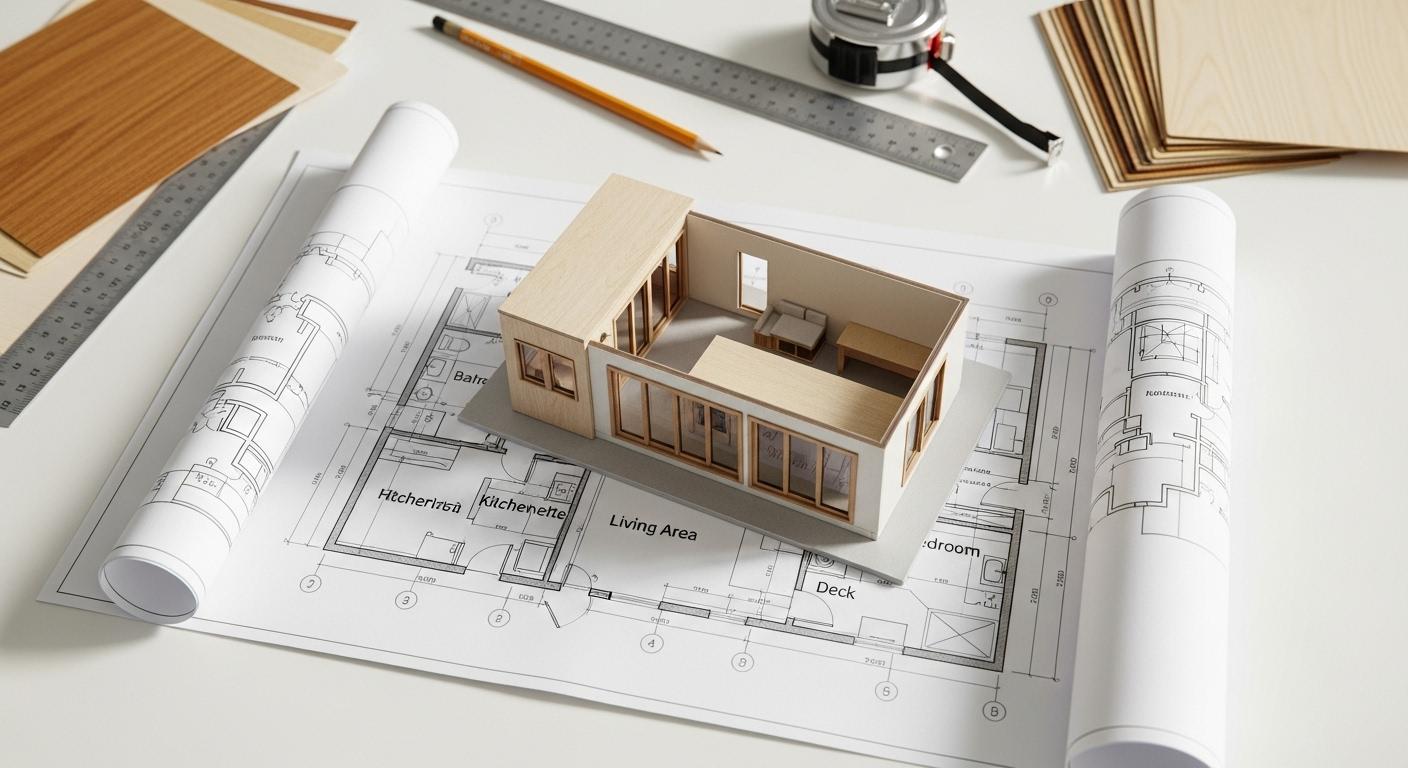
Terms like “flat pack” and “turnkey” solutions are also prevalent. Flat pack refers to homes delivered in flat, packed components, much like those assembly-required furniture pieces we both love and dread. Turnkey, however, refers to homes ready for moving in upon delivery, a delightful all-in-one package. And let’s not forget the magic of Computer-Aided Design (CAD), a technology that transforms blueprints into detailed 3D models, allowing homeowners to visualize their future abode with remarkable precision.
Building Materials and Sustainability
When it comes to materials, variety is the spice of prefab life. Steel, wood, and concrete are staples in prefab construction, each offering unique advantages in strength, aesthetics, or cost-effectiveness. Yet, in an era of environmental consciousness, sustainable materials take center stage. These materials, often recycled or reclaimed, significantly lower the carbon footprint of construction and can even enhance energy efficiency.
Concepts like “insulation,” “R-value,” and “energy efficiency” are integral to understanding prefab homes’ impact on the environment and wallets. The R-value measures a material’s resistance to heat flow the higher the R-value, the better the insulation. And with energy costs ever-climbing, energy efficiency is more than just a buzzword; it’s a blueprint for future-proof living.
